How To Install Zbrush Brushes
ZBrush allows you to customize many of its features to fit the way that you like to work.Over the years, I've used that customizability to create a few special brushesthat have really sped up my workflow.I'm including these brushes as part of this course to help you get some of thesame results that I will be showing you.First of all, if ZBrush is open, go ahead and close it down.Then, you'll want to find your ZBrush program files.On a Mac, you'll navigate to your Applications folder, and then open up the ZBrush folder.
ZBrush allows you to customize many of its features to fit the way that you like to work. Over the years, I've used that customizability to create a few special brushes that have really sped up my workflow. Single User license to XMD ToolBox plugin for ZBrush (3 installs) Access to the Facebook Private XMD Group; Behind the Scenes of what I am working on. Get to chat with others in the industry. Get to vote on upcoming brush sets. 100s of Member Only ZBrush brushes. Get to chat with me. I show Work in Progress of current brushes. 50 custom brushes for ZBrush to sculpt, detail and polish rock formations UPDATE: This pack has been updated with 28 more brushes including VDMs for ZBrush 4R8. The new 'Rock_Brushes_ZBrush_4R8_Update.rar' only works with ZBrush 4R8.Check out this quick video demonstrationAnd there is more info about the update HERE.This pack contains 50 custom brushes to create rocks in ZBrush.
On a PC, you will go to the Program Files (x86), and then open up the Pixologicfolder, ZBrush 4R2, ZStartup, and BrushPresets folder.The customer brushes are located in the Ch_01, Exercise Files, folder 01_01, andyou will just want to select all of these and copy them, and then paste themover in the BrushPresets folder.Now, you can restart ZBrush.

- If you originally purchased an earlier version and never upgraded to the ZBrush 4 series, you will need to submit a Support ticket in order to get your free upgrade to ZBrush 2018. The license was a cross-platform add-on.
- ZBrush has many brushes that do a great job of sculpting. However, there are a few special situations where a special brush can come in handy. With this course I'm providing a few of my own custom brushes for free. Let's see how to install them for use in ZBrush.
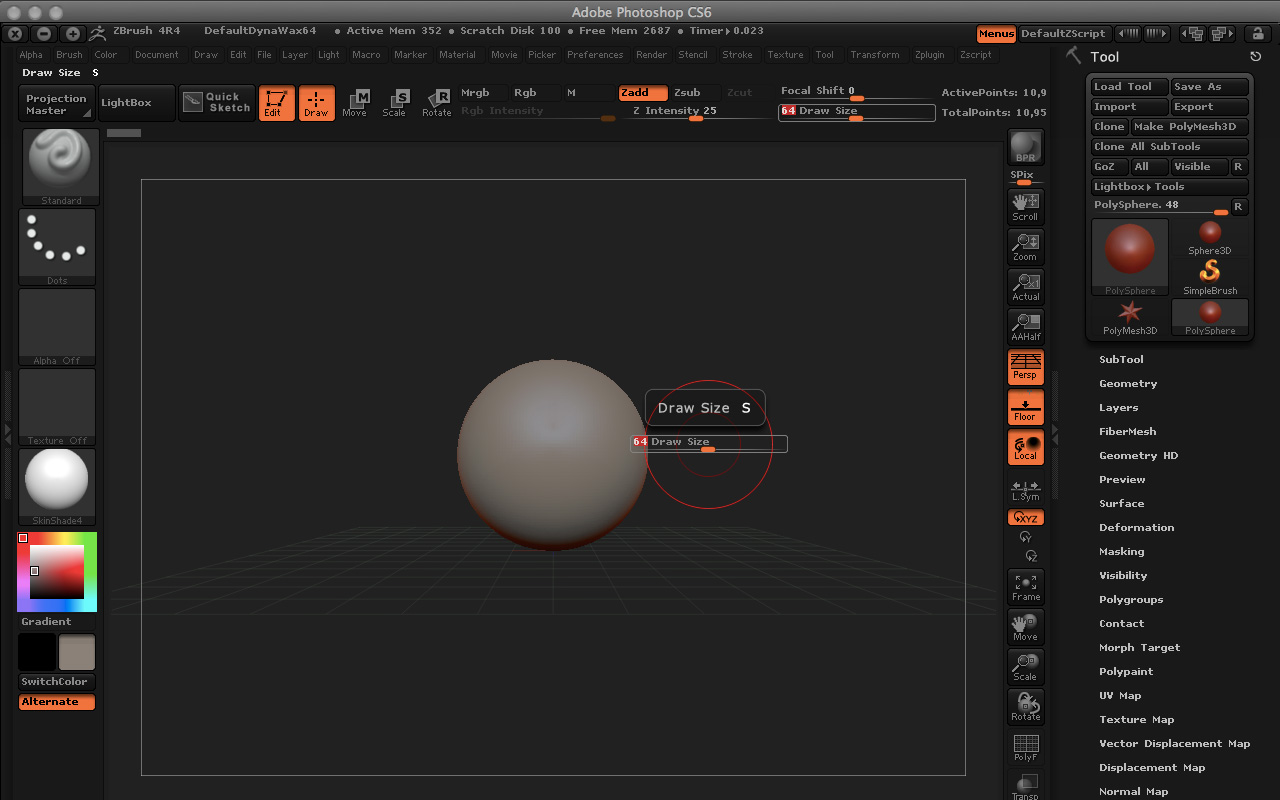
And just to have a model to work on, let's open up the default DynaWax.Double-click on that and let's open up the Brush Palette by clicking on thestandard brush over here.So you can see there is these last three brushes here which are the custombrushes that we just installed.So we've got the crease brush, the customclay brush and the shorthair brush.Let's try them out really quick.Go ahead and click on crease and let's just see how this works.Okay, so you can see that the brush just creates a nice crease on the surface of the model.
To rotate around as a quick reminder, you can just click-and-drag on anyopen part of the canvas.Let's subdivide this surface a few times so that we get a smoother result.I am going to hit Ctrl+D, and just do that three times.Now, let's zoom in here by clicking-and -dragging on the scale, and let's trythat brush one more time.There you get a nice very smooth result.Let's hit B again to open up the Brush Palette and try the customclay brush.There's nothing too fancy about this brush.
It basically just builds up the surface, but in a way that I've customized alittle bit to just make things a little smoother.This brush is based on the clay build-up brush that comes with ZBrush.I will show you how you can customize this brush just in case you don't want toinstall it separately.Go ahead and hit B to open up your Brush Palette, and click ClayBuildup.Now this brush is kind of chunky, kind of rough, kind of blocky.So the way I've customized it is I will go here and turn off the Alpha, and Iwill also go up to Focal Shift, and just slide this to the center.
Then one last adjustment I made was by going to the Brush menu, going down toAuto Masking and turning on BackFaceMask.This makes it so that if you're sculpting on a very thin object, the sculptingwon't pass through from the front to the back of the object.So now you can see you get some nice smooth sculpting with this brush.If you want to save a brush with any customizations that you've made, go up tothe Brush menu and click Save As.You can just give it any name you want, and save it into the Brush Presets wherewe save the other brushes.
And one last brush to check out, hit B, and select the short hairbrush.I am just going to go around to clean part of the model here.Let's shrink the size of the brush a little bit.This brush is good for making short hair like stubble or eyebrows.We're not going to be using it in this course, but I'm giving it away as a nice little bonus.To download these brushes, just go to the free Exercise Files folder on lynda.com.These custom brushes are not necessary for creating great work in ZBrush, butthey do help me work faster, and more efficiently.
Feel free to modify them in any way that helps you work better.
Pixologic’s industry-standard sculpting app has a pretty substantial toolset right out of the box. But there are always ways of adding functionality to an app or improving workflow, and ZBrush is no different.
Zbrush Hair Brushes
Here we’ve rounded up what we consider to be the most useful plugins for extending the app, including some of the ZPlugins provided by Pixologic as part of the installation that new users may not be familiar with.
01. UV Master
How To Install Zbrush Full Version
Cost: Free, installed with ZBrush
To start with lets look at some of the key ZPlugins bundled with the app. There are several worthy of note, but one of the most useful has to be UV Master. Creating UV maps can be a chore, even if you’re familiar with the workflow, and a total mystery if you’re new to CG.
Fortunately, UVMaster takes the drudgework out of it by providing a pretty solid one-click solution, but also allowing you to mark where you’d like your UV seams to sit. Even if you never sculpt with ZBrush, UVMaster is a great tool for rapidly making UV maps for importing into apps for texturing, such as Substance Painter.
Customize and edit all content including the menu backgrounds, logos, buddy objects, voices and behavior of the buddy! This was created on an old Windows XP desktop and I have long since lost the hard drives the code was stored on. Screen buddies download. If I can find the source code, I will release it to the public. You can draw, edit, or replace your own body parts for the buddy, and then mix and match them together using our conveniently designed menus and toolbox.
02. Decimation Master
Cost: Free, installed with ZBrush
Another useful built-in tool is this ZPlugin for reducing the poly count of your high-resolution models. You simply preprocess a mesh or collection of SubTools, define the required point/poly-count or percentage reduction, and hit the Decimate button.
The form and detail of your model is retained, but the number of polygons is drastically reduced, which is handy for getting your ultra-high-res ZBrush sculpts ready for rendering, import into game engines, 3D printing and so on. You can mask areas to retain definition and keep your UVs, but the only slight downside is that the mesh becomes triangulated – if you need quads you’ll have to retopologise by hand or use the ZRemesher tool.
03. GoZ
Cost: Free, installed with ZBrush
GoZ was introduced several years ago and fundamentally changed the way ZBrush interoperates with other apps. When you initialise GoZ it automatically detects other DCC apps you have and installs the relevant plugin. GoZ then acts as conduit between the two, enabling you to send a mesh back and forth between ZBrush and the app you’re using, which includes Maya, Modo, 3ds max, Cinema 4D and Photoshop.
So, for example, you can build a polygonal mesh as normal, send it to ZBrush – to add some fine detailing, create UVs, normal and displacement maps etc. – then send it back to your host app. And, of course you can always start sculpting in ZBrush and GoZ your model for texturing and rendering, which leads us to…
04. ZBrush to KeyShot Bridge
Cost: $149
A key release in 2015 was ZBrush 4 R7 plus KeyShot bridge, a live link between ZBrush and the CPU-based realtime renderer KeyShot. It works with any standalone version of KeyShot, but is also available with cut-down versions called KeyShot for ZBrush, which will only import models from Pixologic’s app. Hit the BPR render button and your mesh, including all SubTools, Polypaint information and MatCaps are sent to KeyShot where you can then add preset materials, lighting setups and HDRIs to produce high resolution imagery.
The Pro version of KeyShot for ZBrush adds high-end functions such as render passes, additional presets, animation, an HDRI editor and more. The bridge alone costs $149, while the HD and Pro versions of KeyShot for ZBrush cost $200 and $400 respectively.
05. ZTree
Cost: Free
As you’d expect from the title, this neat plugin by Ignacio Cabrera Peña helps you build tree structures and then flesh them out with branches and leaves. You can start with either a simple ZSphere chain or use one of the deciduous or coniferous tree presets provided. ZTree will then automatically extend specified branches with ZSpheres and add secondary branches according to the rules laid out in the menu panel.
Orb Zbrush Brushes
It provides a shortcut for trimming branches and also will automatically add PolyGroups for texturing and editing later on. With an adaptive skin applied you can then sculpt areas of detail before adding the preset FiberMesh branches and leaves. ZTree includes an L-System, enabling you to apply rules to your branch generation and to build smaller bushes or more geometric, abstract forms.
06. Terrain Tools
Cost: $2.50
• Support for HANA SP11. • SAP HANA SP12. • Addressed several Incidents. • Support for Safari 9 on Mac OS 10.11. Crystal reports 13 runtime download. Support Pack 16 • • • Support for Edge browser on Win 10.
This brand new plugin – also by from Ignacio Cabrera Peña (currently only available for Windows ) – offers a set of tools for creating realistic terrain. It operates within ZBrush’s 2.5D workspace, with brushes to add hills and valleys, terraces and rivers, plus filters to carve different types of erosion into the landscape.
Once the 2.5D terrain image is completed to your liking, the ‘Make 3D’ button grabs the height map and generates a displaced plane, which you can then sculpt as normal or export into another app for texturing and rendering.
07. NicksTools ZBrush plugin
Cost: Free
Artist Nick Miller has put together this collection of tools and scripts to automate some of ZBrush’s workflow and add a few new features. The collection contains ten tools, plus nine miscellaneous scripts, all accessed from one menu panel.
The main highlights include tools to help you load and save specific projects and ZTools to and from a user-defined ZStartup directory; a SubTool batch-renaming scheme; options for setting SubTool visibility; and a clever system for adding subdivision levels to a high-res model that doesn’t have any. With other tools for handling brush settings, masking, global subdivision and more, this pack is well worth installing.
08. NanoTile Textures
Cost: Free
Created by Pixologic’s Creative Development Manager and digital sculptor Joseph Drust, NanoTile Textures enables you to create seamlessly tiling textures up to 8K resolution. You start by using ZBrush’s Insert Mesh Object and NanoMesh Brush to sculpt a repeating pattern and then Nanotile Textures will render out a variety of tileable passes – Normal, AO, Color, Height, Bump etc – which you can then use to texture and displace a model within ZBrush or in your main 3D app.
09. ZSceneManager – Exoside
Cost: Free/$29
If you’re sculpting huge models with loads of separate elements, it doesn’t take long for ZBrush’s meagre SubTools menu to be become overloaded, which makes keeping track of everything a real chore. Cue ZSceneManager – available in a feature-limited free version and a ‘Pro’ version for $29. In short, it provides a dedicated window in which you can see all your SubTools, hide/show selected elements, enable/disable Polypaint, access subdivision levels, and loads more.
There’s a bunch of options accessible via a right-click menu, although export/GoZ selected SubTools and user-definable commands are limited to the Pro version. It also employs a traditional shift-multiple-select system, unlike the willfully eccentric SubTools menu. ZSceneManager runs as a separate app so the window has to hover over the top of ZBrush, but there’s a ton of useful functionality here for power users.
Zbrush Fur Brushes
10. ZScripts – Eric Blondin
Cost: Free
Here’s another collection of useful scripts, this time from creature artist Eric Blondin. There are 36 functions available from the one menu panel, covering a variety of useful shortcuts and helpers.
It includes things like framing selected SubTools, automatically going to a mesh’s lowest or highest subdivision level, toggling dynamic subdivision, automatic flipping of .obj UVs, automatic creation of colour ID maps and bump maps, and a ton of other little things that bug the day-to-day ZBrush user. And while you’re on Eric’s site you may as well pick up his favourite brushes and MatCaps while you’re there!